
Stainless Steel Shelving
Wire, solid and perforated stainless shelving in 304, 430 and 316 — stationary, mobile, wall-mount, cantilever and dunnage. Sized, specified and shipped by MH-USA.
304 / 430 / 316
Stainless grades stocked
1,000 lb.
Per-shelf capacity, heaviest series
1″
Shelf height adjustment increments
1997
Serving the West from Salt Lake City
Shop Stainless Steel Shelving
A 304 stainless wire shelving starter kit and a Metro stainless dunnage rack, both NSF certified on their product pages, plus a Vestil stainless steel shelving kit for industrial wash-down areas. For mobile units, 316 grade or a full room, request a quote.


Stainless Steel Shelving, Specified Correctly the First Time
Stainless steel shelving is the storage you buy when the room is wet, when it gets sanitized on a schedule, or when what sits on the shelf is worth more than the shelf. Chrome and epoxy are cheaper and fine in dry stockrooms, but add standing water, steam, chlorinated sanitizer, brine or a daily hose-down and chrome blisters and epoxy chips. Stainless is the finish that still looks like an asset five years in.
The trouble is that “stainless” on a submittal tells you almost nothing. A 430 wire shelf and a 316 solid shelf behave completely differently in a chloride-heavy room, and a 1,000 lb. rating on a 36-inch shelf is not the same on a 72-inch shelf.
MH-USA quotes stainless shelving for kitchens, walk-ins, food and beverage plants, labs, cleanrooms, healthcare and industrial storerooms, and we ship nationwide.
Wire vs. Solid vs. Perforated Stainless Shelving
Every project starts with one decision: what does the shelf deck look like? Three answers cover almost every application, and the right one often varies tier by tier.
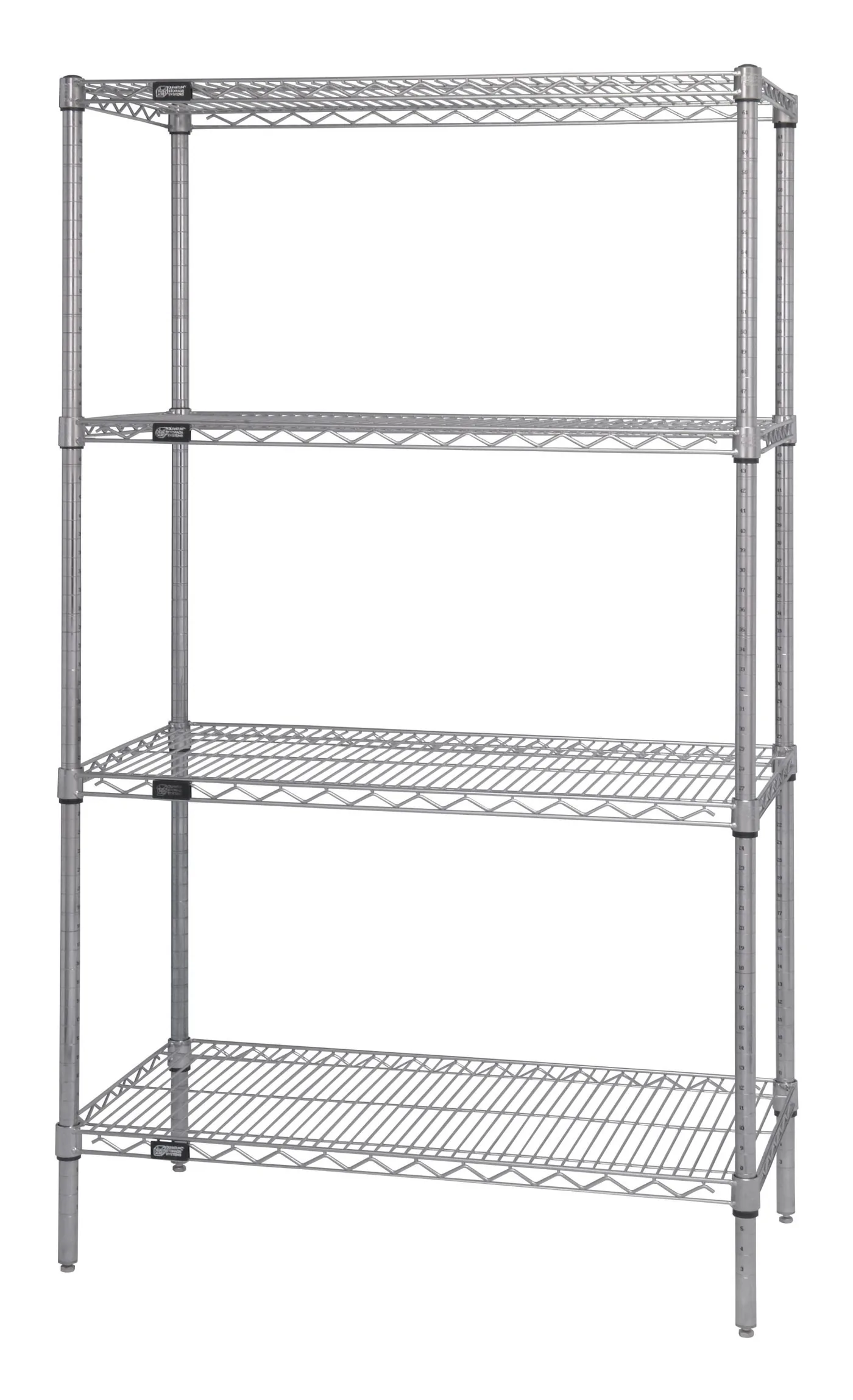
 Wire ShelvingOpen-wire decks with a truss-reinforced profile that adds stiffness and a small retaining ledge. Air circulates, water never pools, and light and sprinkler spray pass through. The default for coolers, freezers and dry storage.
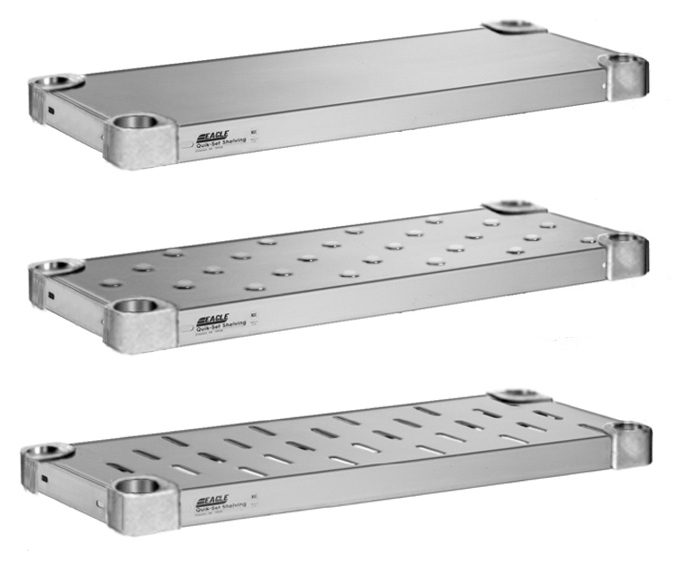
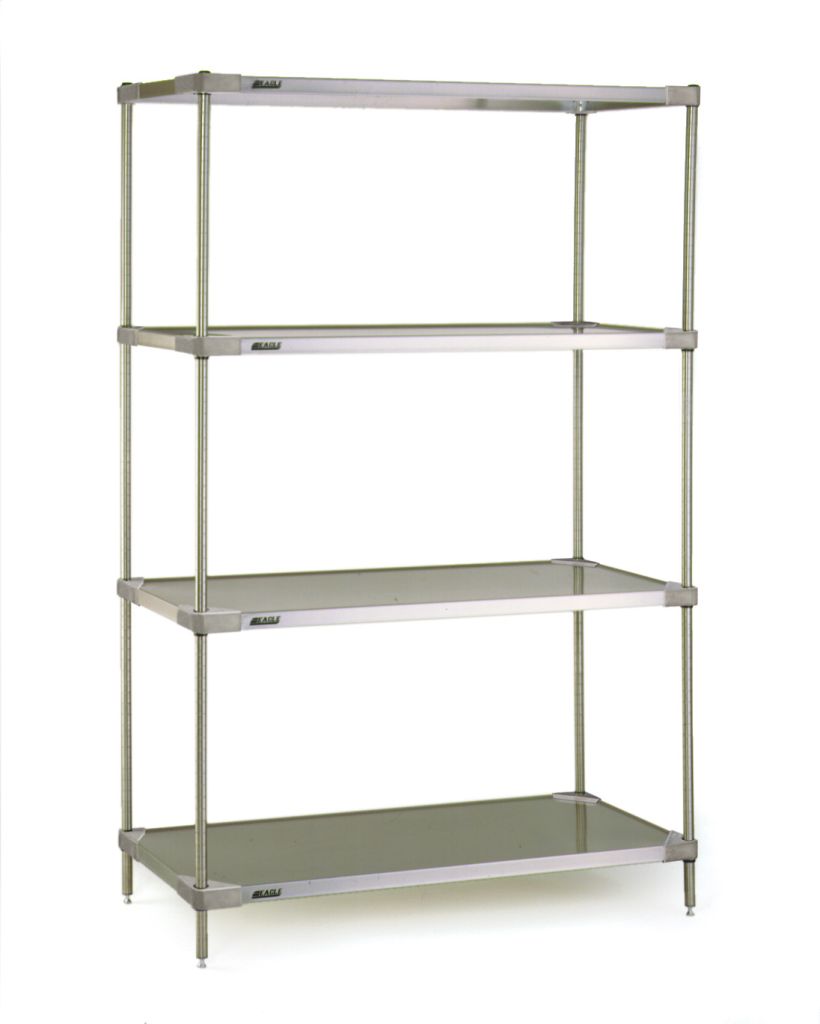 Solid ShelvingHemmed, double-thickness decks with a raised marine edge on all four sides. Spills stay put, small parts cannot fall through, and the surface wipes clean in one pass. Right for prep areas, labs and pharmacies.
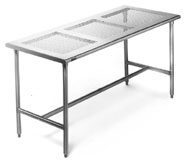 Perforated StainlessA middle path for controlled environments: a stainless deck punched so laminar airflow is not blocked while the surface stays wipeable. Also used for gowning benches and cleanroom tables.
Mix deck types in one unit
Nothing says a unit has to be all wire or all solid. A solid or dunnage bottom tier where spills happen, solid at working height, and wire above for airflow is a very effective configuration — and because every shelf locks onto the same numbered posts, you can change your mind later.
304 vs. 430 vs. 316: Picking the Stainless Grade
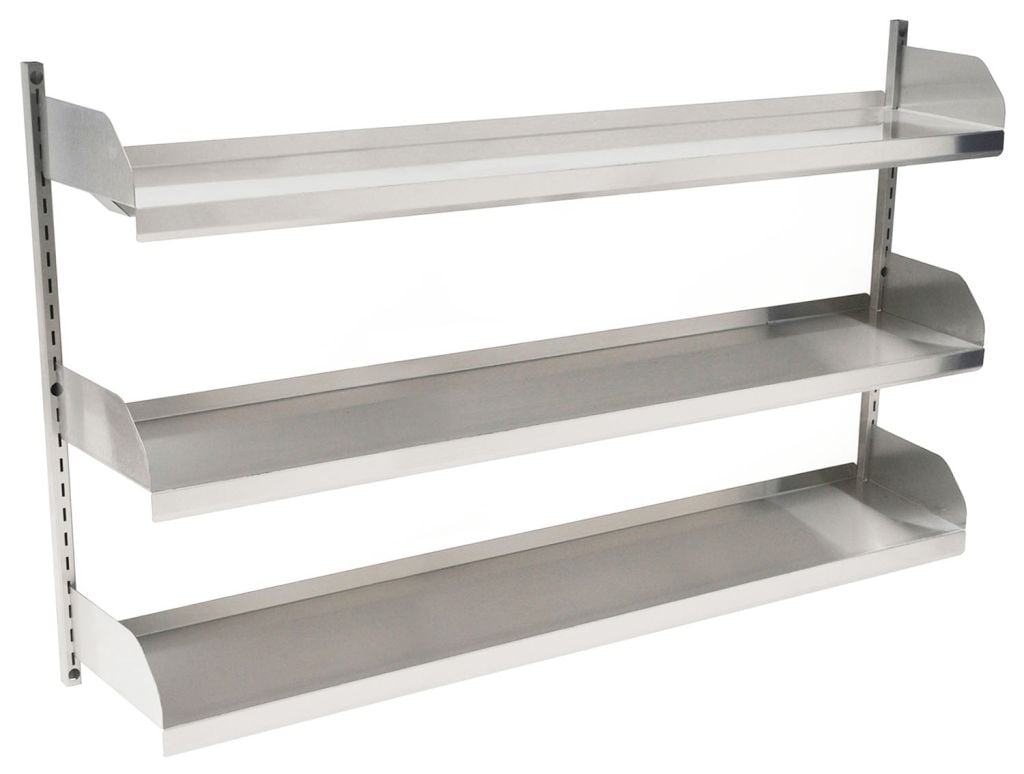
Grade is the most expensive thing to get wrong, in both directions: 316 in a dry stockroom wastes money, 430 in a brine room gets replaced. It comes down to nickel and molybdenum.
Type 430 is ferritic — chromium, essentially no nickel. Magnetic, cheaper than 304, fine in dry and intermittently damp rooms, but it stains and pits quickly around standing water, salt or chlorinated cleaners.
Type 304 is the austenitic 18/8 workhorse: about 18% chromium, 8% nickel. The nickel stabilizes the passive layer and makes 304 far more forgiving of moisture, food acids and routine sanitation chemistry — the default for kitchens, coolers, labs and processing rooms.
Type 316 adds roughly 2–3% molybdenum, which specifically resists chloride pitting. Salt, brine, high-concentration chlorine sanitizers and many lab reagents are chloride problems — that is where 316 earns its premium.
Practical approach: 304 as the standard, 430 where the room is genuinely dry, 316 only in the bays that see chlorides.
| Grade | Alloy character | Corrosion behavior | Where it belongs |
|---|---|---|---|
| 430 | Ferritic, chromium, no meaningful nickel, magnetic | Resists dry-air corrosion; stains and pits under standing water, salt and chlorinated cleaners | Dry storerooms, stockrooms, light-duty back-of-house, budget-driven jobs |
| 304 (18/8) | Austenitic, ~18% chromium / ~8% nickel | Strong general corrosion resistance to moisture, humidity, food acids and routine sanitizers | Commercial kitchens, coolers and freezers, labs, pharmacies, healthcare, most processing |
| 316 | Austenitic with ~2–3% molybdenum added | Adds specific resistance to chloride pitting and crevice corrosion | Brine and salt handling, high-chlorine sanitation, marine, chemical and pharma bays |
| Chrome / epoxy (comparison) | Plated or coated carbon steel | Blisters and chips once breached; rust follows | Dry storage only — not a stainless substitute |
Gauges, Spans and Real Weight Capacities
Gauge runs backwards: a lower number is thicker metal. Heavy-duty solid stainless shelving is 14- or 16-gauge, hemmed to a two-fold thickness with a 2-inch downturn and a marine edge on all four sides — that geometry, not just the gauge, is where the stiffness comes from — and the heaviest series rates 1,000 lbs. evenly distributed per shelf.
Wire shelving gets its strength from truss-shaped front and rear rails that double as a retaining ledge; stainless wire shelves commonly rate 600 to 800 lbs. Dunnage platforms on 14-inch posts run about 600 lbs. Lab wall shelves are typically 16-gauge with a reinforced center hat channel and a rear upturn.
| Shelf type | Typical construction | Indicative capacity | Notes on the rating |
|---|---|---|---|
| Heavy-duty solid | 14 or 16 gauge, 2″ downturn, marine edge, aluminum corner castings | Up to 1,000 lbs. per shelf | Evenly distributed; falls off as the shelf gets longer |
| Truss-reinforced wire | Formed wire deck with truss front and rear rails | 600–800 lbs. per shelf | Open deck; ledge helps retain product |
| Dunnage platform | Wire shelf on 14″-high posts | About 600 lbs. | Designed for sacks, cases and bulk, not point loads |
| Cantilever tier | Rear uprights only, sheet metal or wire overlays | Per-arm rated by length | No front posts, so loading is at the arm, not the corner |
Evenly distributed is not the same as loaded
Every published capacity assumes weight spread across the whole deck. A 400 lb. drum on a quarter of a shelf is a point load and can exceed the design even when the spec-sheet number looks generous. For dense items — drums, castings, buckets of concentrate — send us the item weight and footprint so we size the shelf and post to the real load.
How Post-and-Shelf Systems Go Together
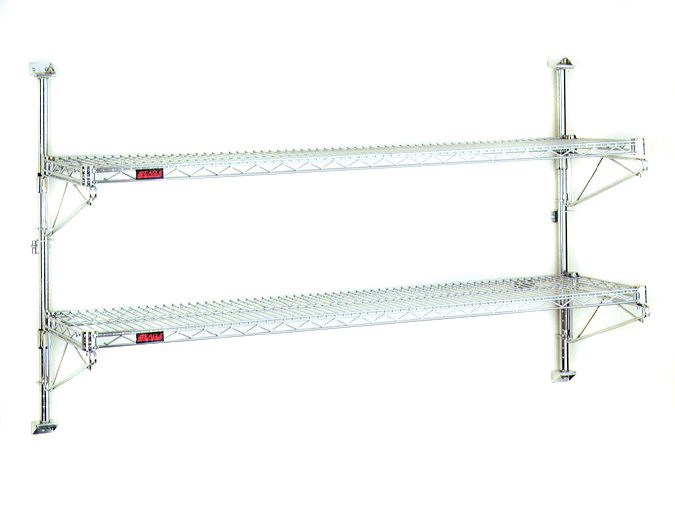
Nearly all stainless shelving is a post-and-shelf system. Posts are numerically calibrated and grooved on 1-inch centers; tapered split sleeves snap on at the number you choose and the shelf collar slides over them, so the taper tightens the lock as load increases. No tools, and the tier layout adjusts in 1-inch increments over the full post length.
That is why you plan in starter and add-on units. A starter has four posts; an add-on shares two with the unit beside it, so a long wall run costs less per linear foot and stays in plane. Order a row of starters and you paid for posts you did not need.
Leveling feet come standard for uneven and sloped floors: a unit out of plumb loads its posts unevenly and the shelves stop seating flat. Accessories all hang off the same post system — dividers, ledges, label holders, hooks, panels and security modules that convert part of a unit into a locking cabinet.
Stationary, Mobile and High-Density Shelving
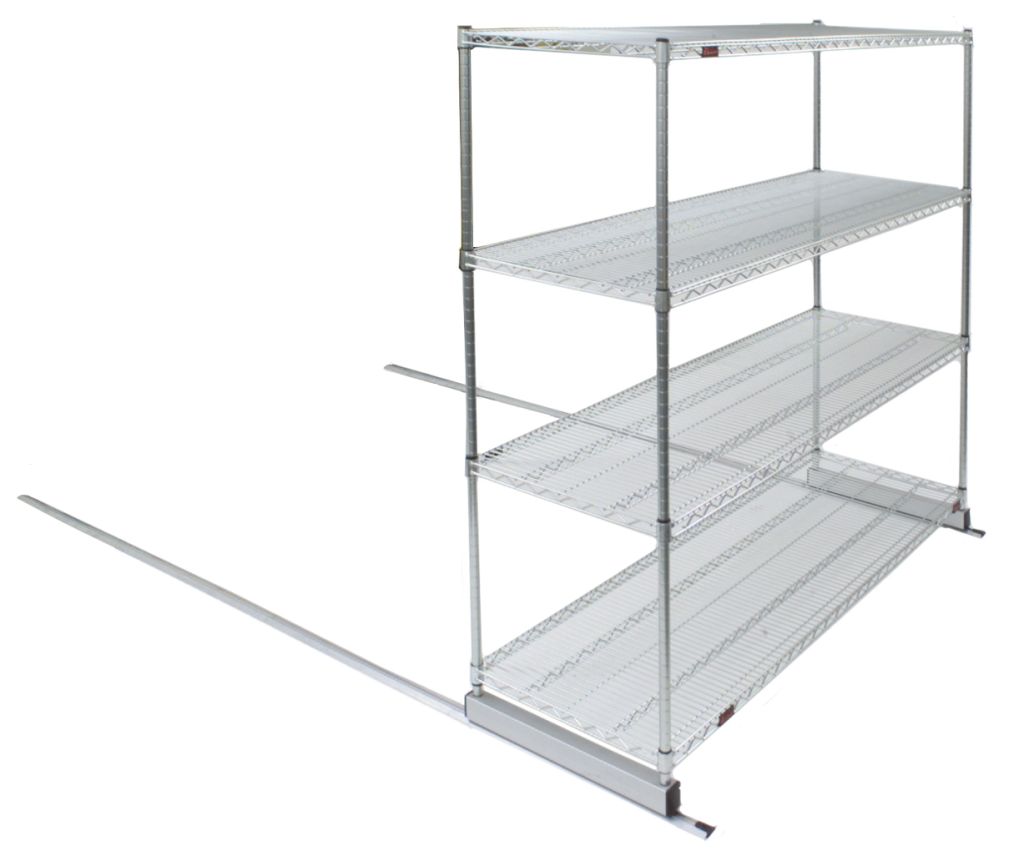
The same unit can be stationary on leveling feet or mobile on casters, and the choice is usually sanitation rather than transport. The floor under a stationary unit never gets mopped properly, and that floor is what an inspector kneels down to look at. Mobile units — typically four 5-inch swivel casters, two braked — roll out so the crew can clean underneath.
When density is the constraint, high-density track systems put units on non-corrosive aluminum floor tracks with end stops so a bank of units shares one aisle. Tracks, skate kits, posts and shelves are ordered as separate line items — a detail that trips up first-time buyers.
 Stainless Utility CartsThree-shelf stainless carts with upturned edges. See our utility carts page.
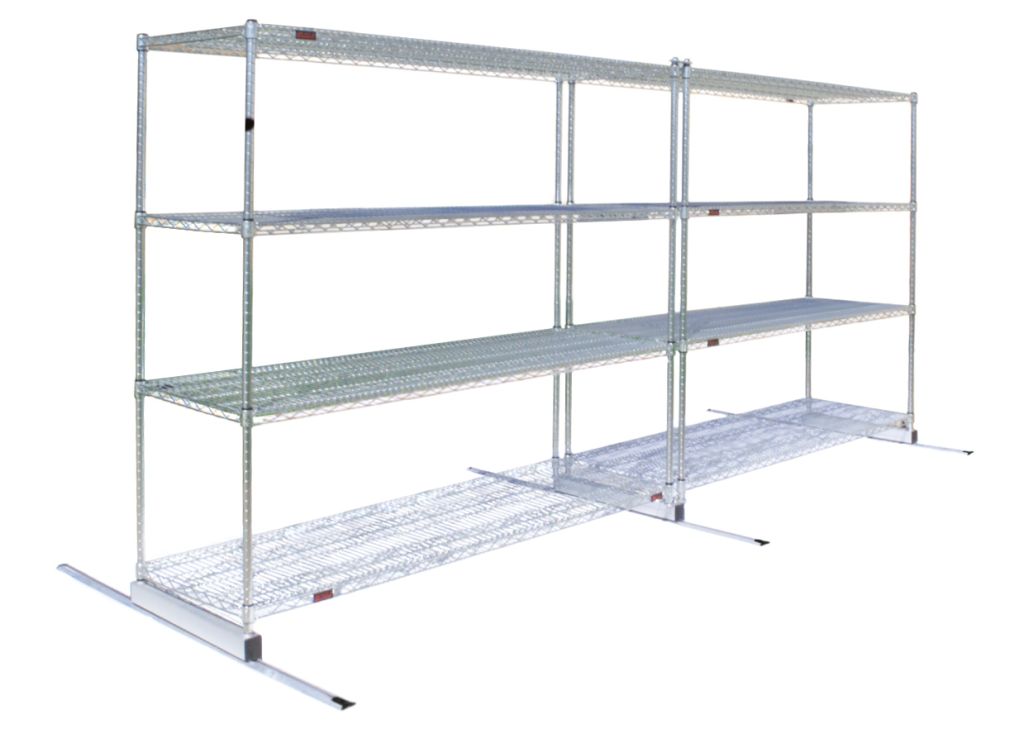 Double-Deep Track SystemsMaximum density for cold rooms and archive storage where product is uniform and access is scheduled.
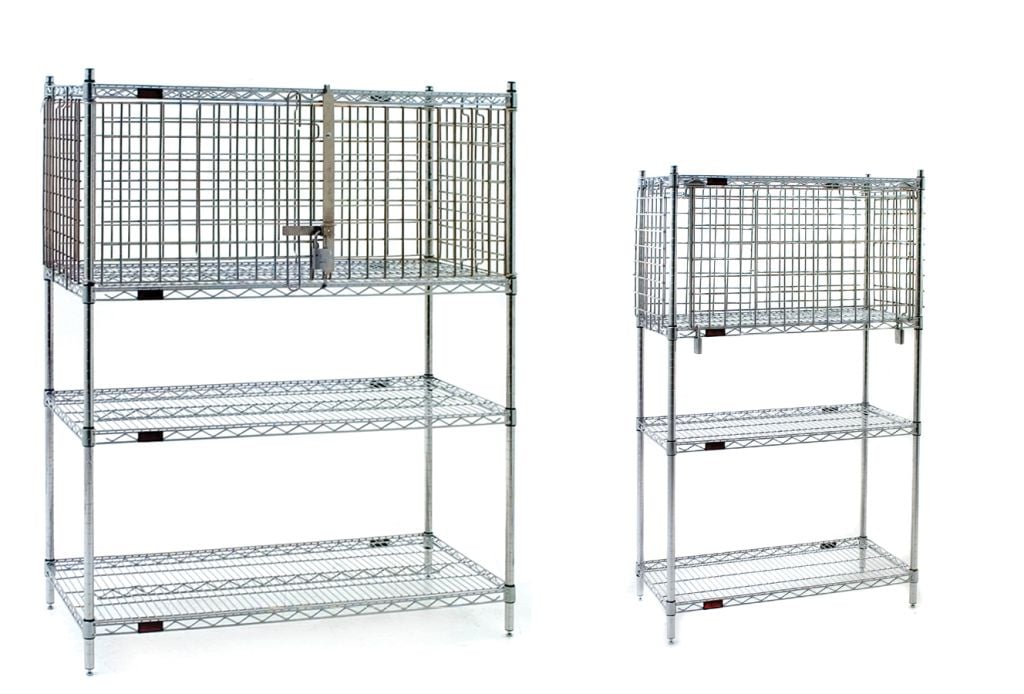 Security ModulesLock up controlled stock, tools or high-value consumables inside an existing run instead of building a cage.
Wall-Mount and Cantilever Stainless Shelving
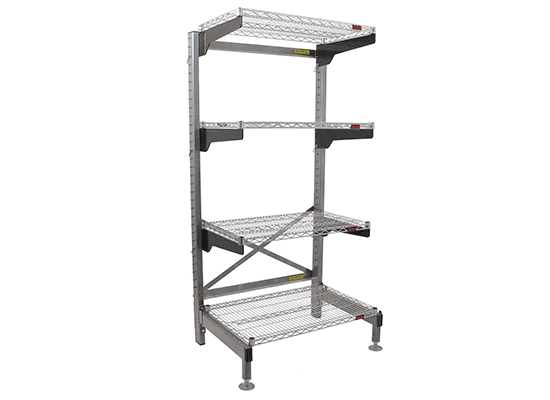
Floor space is the expensive part of any room, so a lot of stainless shelving never touches the floor. Wall-mount options run from simple bracket-and-shelf kits to adjustable-post wall mount kits that put a full post section on the wall, with positive top and bottom mounting, a center support and 1-inch height adjustment.
The constraint on a wall shelf is never the shelf — it is the wall. Send a photo and a note on the substrate and we will pick a mounting method that does not rely on drywall anchors.
Cantilever shelving removes the front uprights entirely. Loads carry on rear uprights with 2-inch adjustment, so an operator slides a tote in from the front instead of lifting it over a post. Widths commonly run 18 to 30 inches and lengths 24 to 72 inches, with sheet-metal or wire overlays, and freestanding units give access to all four corners.
 Stationary Wall MountsBracket sets with a stainless mounting plate where a floor unit will not fit.
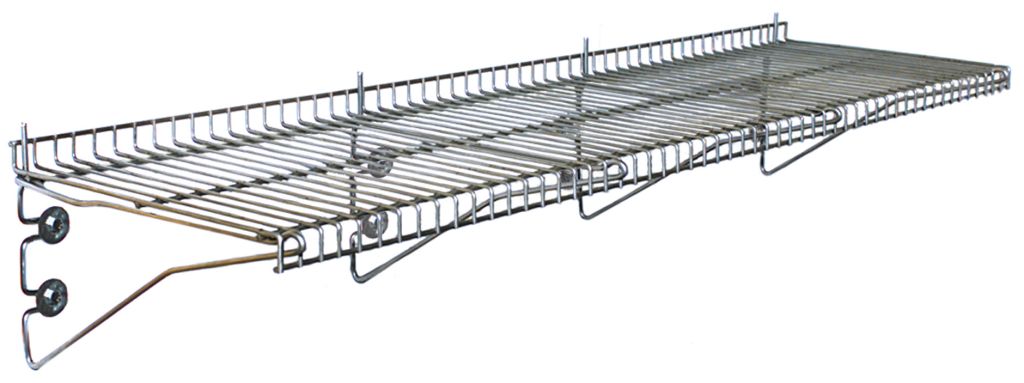 Slide-Mount Wire Wall ShelvesWire wall shelves that hang and lock into place above prep and packing benches.
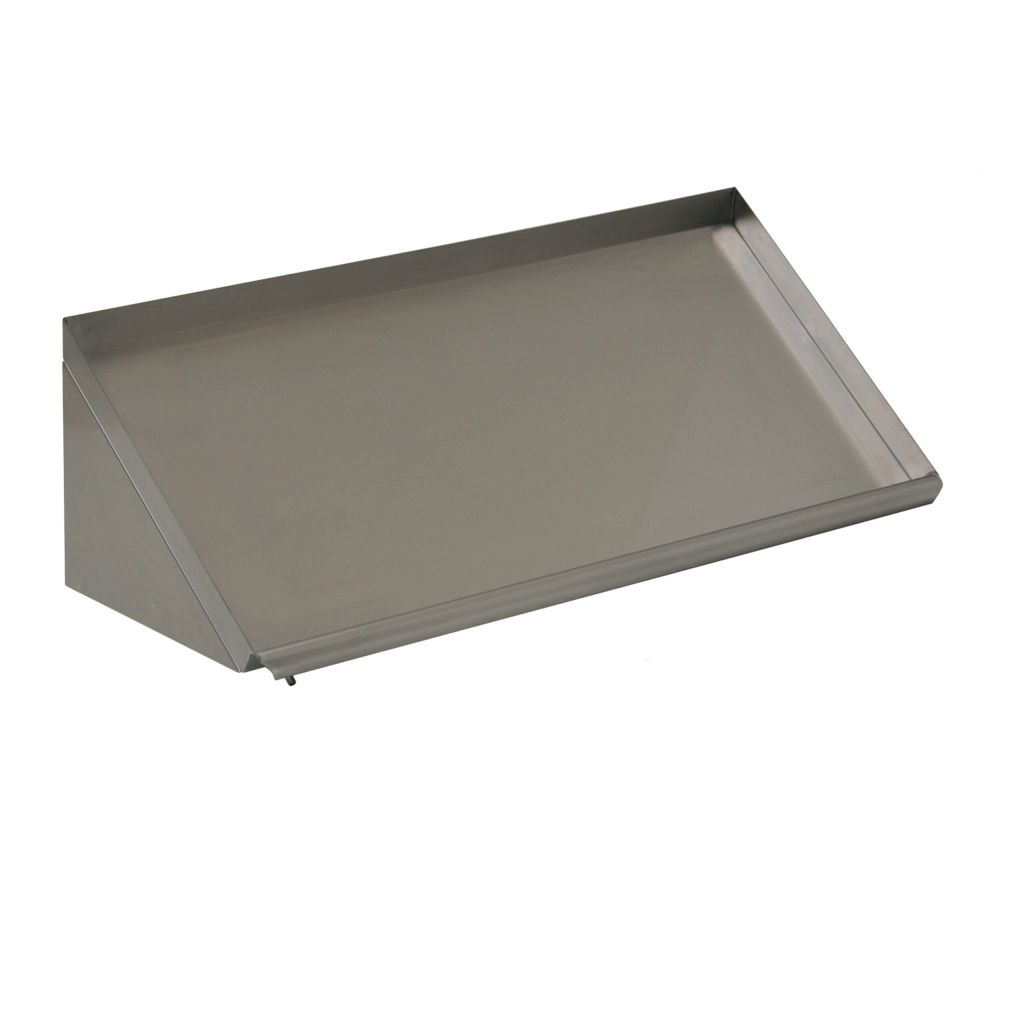
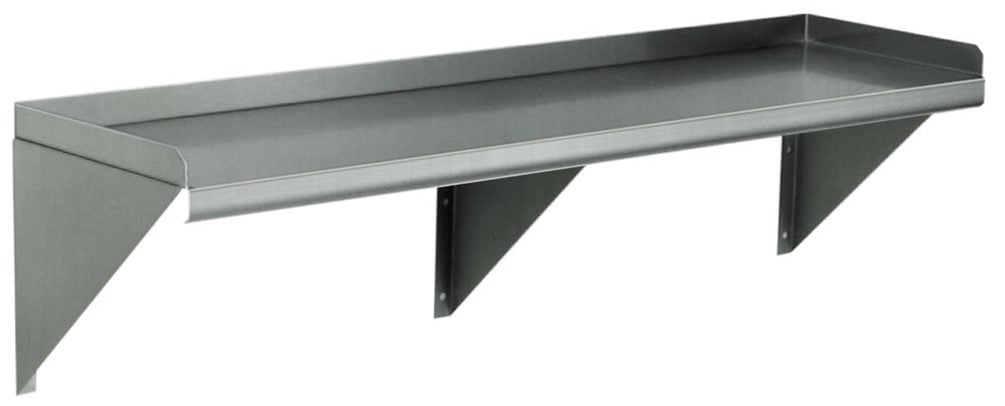
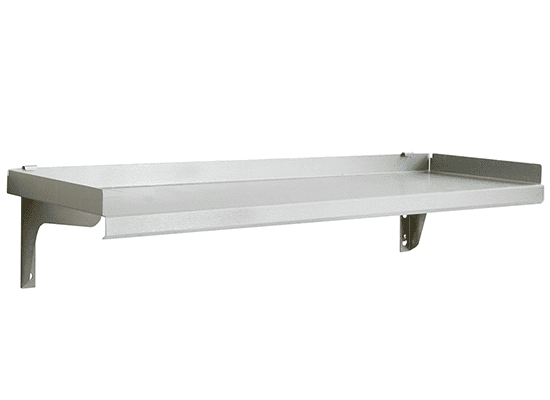 Solid Wall ShelvesSolid decks with a rolled front edge where a wire deck would drop small items.
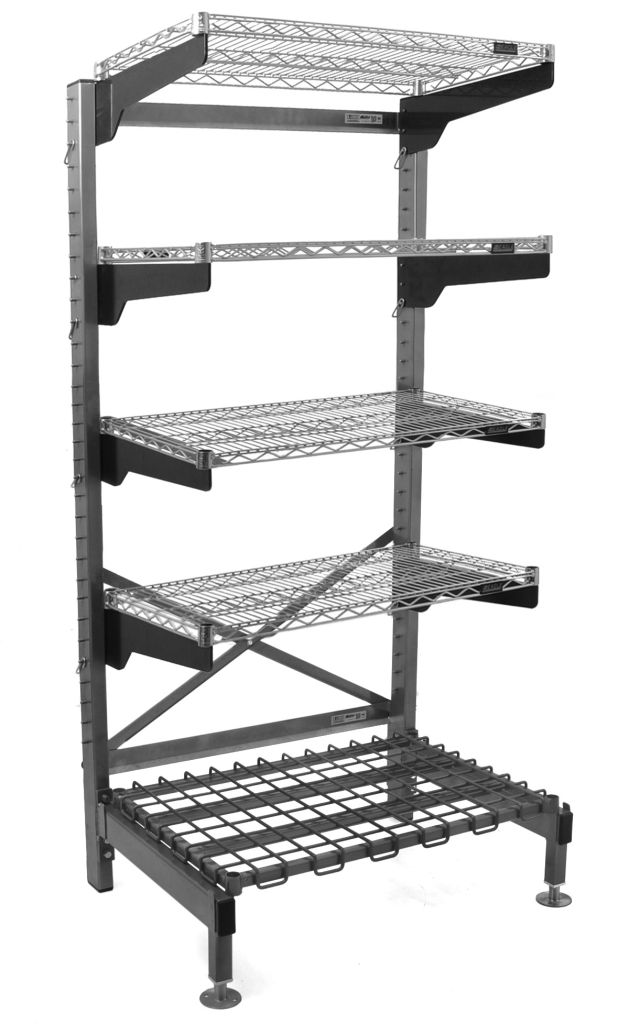 Cantilever With Dunnage BaseCantilever units with a bottom dunnage shelf so bulk sits off the floor.
Dunnage Bases and Off-Floor Storage
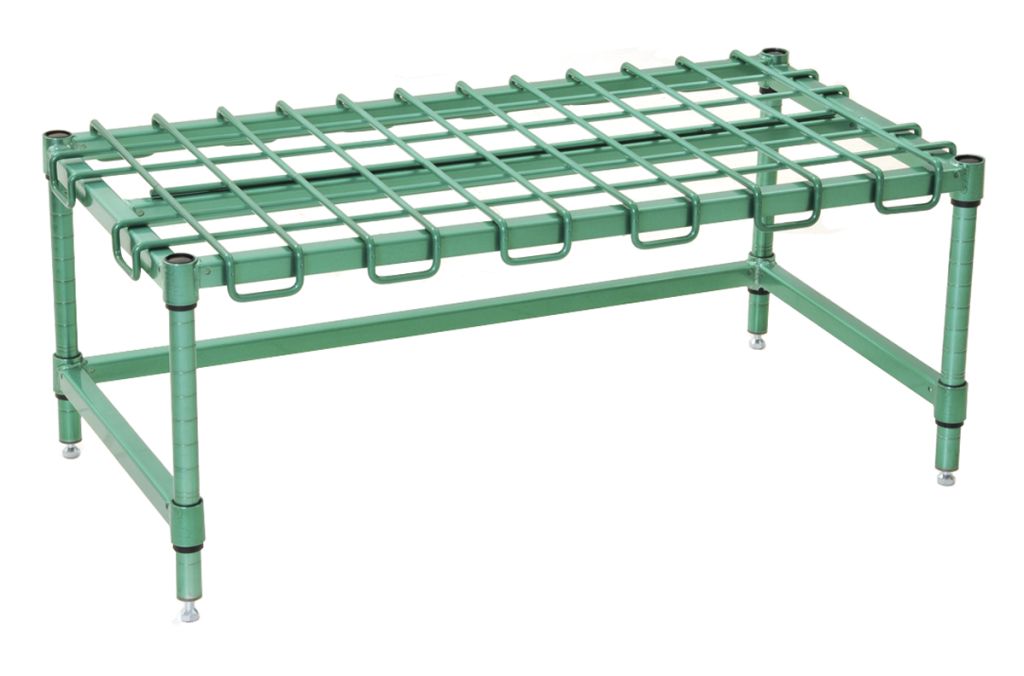
A dunnage rack is the low platform that holds bulk product — sacks, cases, drums — off the floor at roughly 12 to 14 inches so a mop and a hose reach underneath. Off-floor storage is one of the first things an auditor checks.
Stainless dunnage shelves use a four-sided frame with center supports and a removable wire mat that lifts out to be washed. Dunnage racks add 1-inch posts grooved on 1-inch centers with a three-sided frame for maximum load, stationary or mobile on four 5-inch casters, two braked.
The most common mistake is dunnage too short for the case pattern stored on it — measure the footprint of the load, not the aisle.
 Aluminum Dunnage RacksWelded aluminum frames that will not rust, for moderate loads in wet rooms.
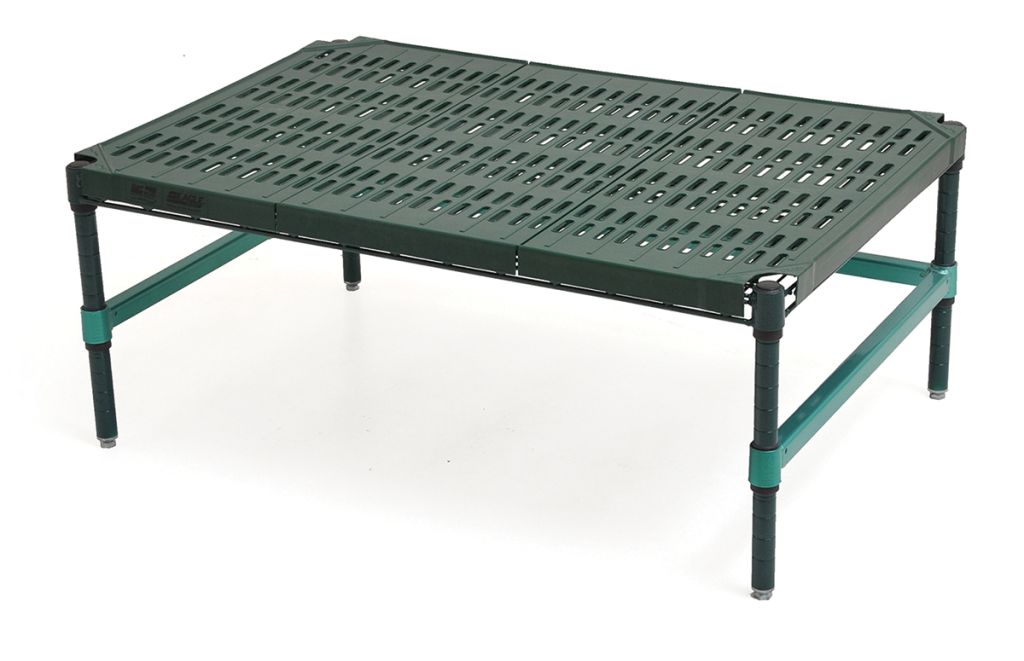 Polymer Dunnage RacksRemovable louvered polymer mats lift out and wash — good for messy cooler floors.
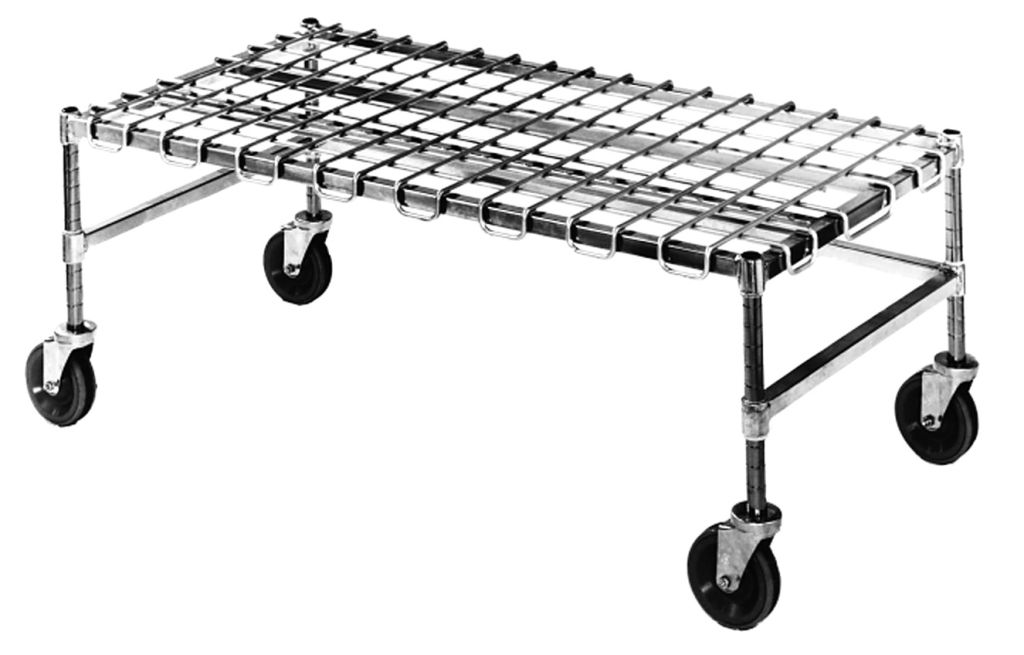 Mobile Dunnage RacksThe same rack on swivel casters, so a loaded base rolls aside for floor cleaning.
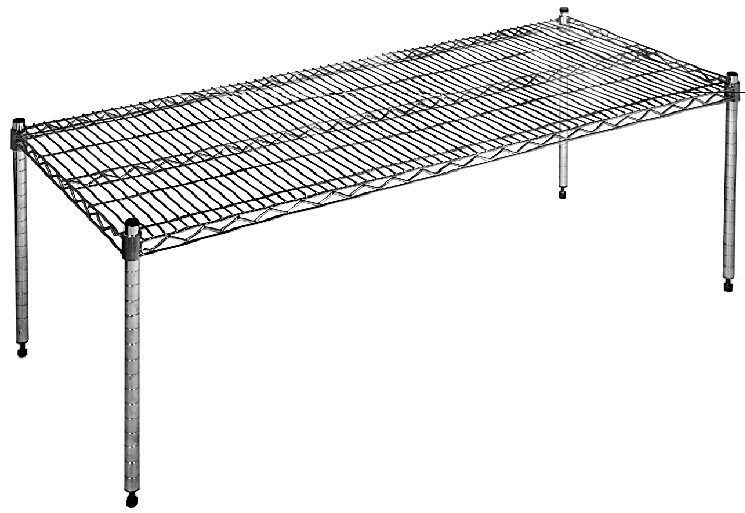 Dunnage PlatformsLow truss-reinforced platforms, commonly rated around 600 lbs., for sacks and cases.
Wash-Down, Cleanability, Corrosion and Anchoring
Stainless is not maintenance-free; it is failure-tolerant when treated correctly. Almost every “the stainless rusted” call traces back to one of these.
- Chloride exposure. Chlorine sanitizers, salt and brine attack the passive layer and cause pitting. Rinse after sanitizing, never let cleaner dry on the surface, and move to 316 where chloride contact is routine.
- Free-iron contamination. Grinding sparks and carbon-steel wool embed iron particles that rust in place and look like a stainless failure. Use non-metallic pads and keep fabrication debris off finished shelving.
- Trapped moisture. Water sitting in a crevice under a load corrodes faster than water on an open surface. Wire decks drain; solid decks with a marine edge hold liquid on purpose, so wipe them rather than just rinsing. Tool-free sleeves also let a crew lift a tier out and wash it properly.
- Clean the floor, not just the shelf. That is what mobile bases and dunnage are for. If a stationary unit blocks floor cleaning, put it on casters.
- Anchor tall units. Tall, narrow, heavily loaded units in seismic regions — Utah included — should be wall-anchored or ganged, heavy product low. Anchoring requirements come from your engineer and building official; send us the requirement and we will supply hardware to suit. We do not certify seismic compliance.
- Confirm listings in writing. Sanitation and safety listings are model-specific, not line-wide. Send your model numbers and we will confirm current listing status per item before you order.
Sizing and Laying Out a Shelving Run

Shelf depths commonly run 14, 18, 21, 24 and 30 inches; lengths 24 through 72 inches; posts from dunnage height through 63, 74, 86 and 96 inches. Those are the easy numbers — these are the decisions that make a storeroom work:
Depth is set by reach, not wall length. An 18-inch wall shelf is fully reachable; a 24-inch shelf becomes where product goes to be forgotten unless it is reachable from both sides. Deep shelving belongs on island runs.
Tier spacing is set by the tallest case plus lift clearance. Measure the tallest carton you actually receive, add clearance, and lay tiers out from the bottom up. A plan that assumes uniform 12-inch spacing is usually wrong.
Aisles are set by what moves through them. Hand-carried product needs about 36 inches, a utility cart 42 to 48, a pallet jack more. If aisle width binds, high-density track systems usually cost less than the square footage they save.
Heavy low, light high. Better stability, fewer lifting injuries, and fast-moving items land in the zone between knee and shoulder height.
Send us your room dimensions
Email a sketch, a plan or a phone photo with a tape measure in it, plus a note on what gets stored and how wet the room gets. You get back a unit-by-unit layout with grades, capacities, accessories and freight. Call (800) 326-4403.
Stainless Shelving Brands We Represent
This page is the neutral category overview. If you already know the manufacturer or product family you want, these pages go deeper.
- Eagle lab products — we represent Eagle Group; stainless lab shelving, casework and benches
- Eagle cleanroom products — cleanroom stainless shelving and controlled-environment furniture
- Sanitation-rated shelving solutions — how third-party sanitation listings work on shelving
Why we keep generic and brand pages separate
This page compares construction, grades and configurations without steering you toward one manufacturer. The brand pages exist for when you have standardized on a line and need model-level detail. We represent Eagle Group and source other manufacturers when a project calls for it.
Stainless Steel Shelving in Utah and Nationwide
MH-USA has supplied stainless steel shelving in Utah since 1997, and our Salt Lake City operation covers restaurant and hospital kitchens, food and beverage plants along the I-15 corridor, and labs and cleanrooms in the research parks. Being local, we can walk a room, take our own dimensions and coordinate delivery around the trades.
Two local wrinkles: seismic anchoring matters here, so tall loaded units should be anchored or ganged per your engineer; and the dry climate makes 430 reasonable in genuinely dry storerooms — but once a room has a floor drain or gets hosed down, 304 is the answer.
Outside Utah, we ship stainless shelving nationwide with freight quoted alongside the equipment. Call (800) 326-4403 and we will size the units, confirm capacities and get you a delivered price.
Design & price it online: Metro Wire Shelving Configurator
Configure Super Erecta wire shelving units, posts, shelves and casters in our free Metro Wire Shelving configurator — build the layout, see a full bill of materials and save or send the quote in minutes. Need a different Metro product? Browse all 17 tools in the Metro configurator hub.
Compare boltless, steel, wire and bulk rack units by capacity on our main industrial shelving page.
Get a free quote
Tell us what you are storing, the room size and your timeline. A project specialist will follow up with layout options and pricing. Prefer to talk? Call (800) 326-4403.
Stainless Steel Shelving FAQ
What is the difference between 304 and 430 stainless steel shelving?
When do I need 316 stainless instead of 304?
How much weight can a stainless steel shelf hold?
Is wire or solid stainless shelving better?
Can stainless steel shelving rust?
Do you sell stainless steel shelving in Utah, and do you ship elsewhere?
Get Your Stainless Shelving Quote
Send the room dimensions, the product list or the schedule. We will size it, spec the grade and ship it. Call (800) 326-4403.