Get a Quote Today!
Don’t wait any longer to enhance your warehouse operations. Request a quote for Spring-Rail Pushback Pallet Racks and see the difference they can make for your business.

What Makes the Spring-Rail Pushback Pallet Rack an Essential Storage Solution?
A Spring-Rail Pushback Pallet Rack is a high-density storage system that maximizes warehouse space by utilizing a series of nested carts on inclined rails. This durable racking solution allows for multiple pallets to be stored on a single pallet racking system, offering efficient use of space and enhanced inventory management.

Upgrade your storage system with Spring-Rail Pushback Pallet Racks today. Contact us for a free consultation and discover how you can maximize your warehouse space and improve efficiency.
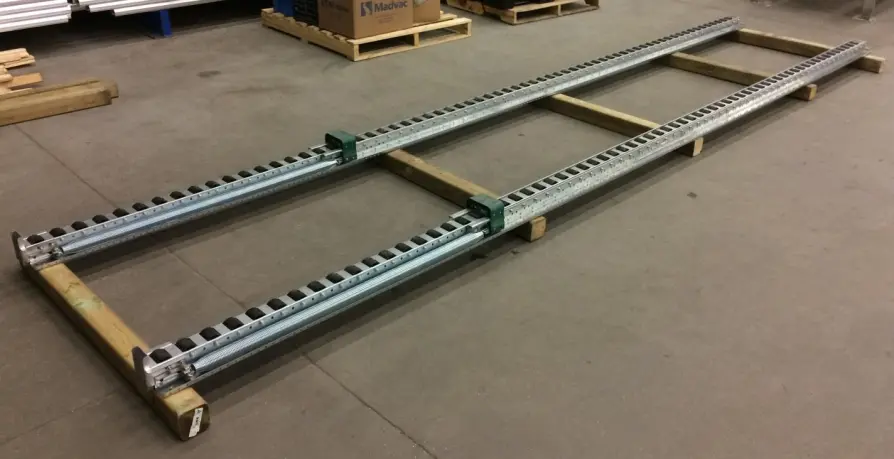
A spring-rail pushback rack uses the principles of gravity and mechanical assistance to store pallets up to six deep on a single lane. The system is built on a Last-In, First-Out (LIFO) inventory management principle.
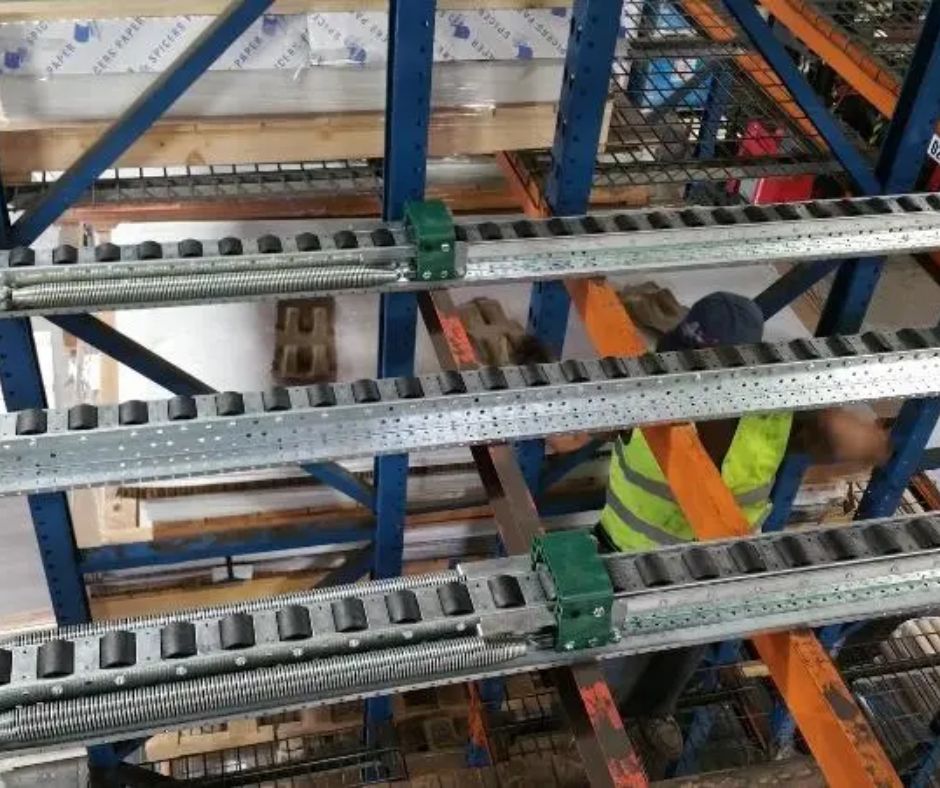
Inclined Rails: Each pallet position in a lane is built on a set of slightly inclined steel rails. This incline allows gravity to do its job, ensuring that when the front pallet is removed, the pallets behind it gently glide forward to the picking face.
Nested Carts: A series of wheeled carts are nested on top of the rails. Each cart is designed to hold one pallet. A two-deep system has one cart, a three-deep system has two carts, and so on. The final pallet rests directly on the rails.
The Spring-Rail Mechanism: What distinguishes this system is the integrated spring assembly. As a forklift pushes a pallet into the lane, it compresses a series of heavy-duty springs. When a pallet is unloaded from the front, this stored energy in the springs helps to gently push the remaining carts forward, ensuring a smooth and controlled return to the picking position.
Loading: A forklift driver places the first pallet onto the top cart at the front of the lane. To load the second pallet, the driver aligns it and gently pushes the first pallet and cart back, revealing the next nested cart. This process is repeated until the lane is full, with the last pallet resting on the rails.
Unloading: The driver removes the front pallet. Once it is clear, the compressed springs and gravity work together to bring the next pallet and its cart forward to the front picking position, ready for retrieval.
Choosing the right system depends on your specific operational needs.
Pushback is faster to operate and provides better selectivity (a different SKU per lane). It also reduces the risk of rack damage since forklifts do not enter the structure. Drive-In may offer slightly higher density but is best for large batches of the same SKU where speed is not a priority.
The main difference is the inventory rotation method. Pushback uses LIFO (Last-In, First-Out), while Pallet Flow uses FIFO (First-In, First-Out). Pallet Flow is ideal for perishable goods, while Pushback is better for items that do not have a strict expiration date.
Both are effective pushback systems. Spring-rail uses a spring mechanism to help push carts forward, providing a more controlled return. Pitch-rail pushback pallet racks rely solely on a steeper rail incline (pitch) and gravity. The choice between them can depend on the weight and consistency of your pallet loads.
Don’t wait any longer to enhance your warehouse operations. Request a quote for Spring-Rail Pushback Pallet Racks and see the difference they can make for your business.

Pushback racking is a versatile solution suitable for a variety of industries.
Food and Beverage: For non-perishable goods or products produced in large batches (like canned goods or bottled beverages), the LIFO system is highly efficient.
Third-Party Logistics (3PL): 3PL providers benefit from the flexibility to store different client SKUs in each lane and the ability to maximize storage space for better profitability.
Manufacturing: Manufacturers can use pushback racks to store bulk quantities of raw materials or finished goods, creating an effective buffer for production lines.
A successful implementation requires careful planning.
Lane Depth: Pushback systems are commonly designed for depths of 2 to 6 pallets. The optimal depth depends on your inventory levels and turnover rate.
Pallet Quality: Pallets must be in good condition to move smoothly on the carts and rails. Damaged or low-quality pallets can cause operational issues.
Forklift Operator Training: Operators need to be trained on the specific technique of pushing pallets back gently to avoid damaging the product or the rack system.
Safety and Inspections: Regular inspections are essential to ensure all components are in good working order. For comprehensive safety protocols, refer to these 7 Essential Pallet Rack Safety Guidelines for Warehouses.
Our Comprehensive Guide to Selecting Pallet Rack for Your Warehouse provides further insights into planning your system.
Choosing the right type of racking is critical. Here’s how lightweight systems compare to their heavy-duty counterparts.
Maximum Storage Density
Compared to standard selective racking, a pushback system can increase your storage capacity by up to 90%. By reducing the number of required aisles, you convert unused aisle space into valuable storage positions. This allows you to store significantly more product without the high cost of expanding your warehouse.
Improved Picking Speed and Selectivity
While Drive-In racking offers high density, it requires forklifts to enter the structure, which is slow and limits access. Pushback racking allows operators to load and unload from a single aisle without entering the rack. Furthermore, each lane can be dedicated to a different SKU, providing far better selectivity and making it easier to manage a diverse range of products.
Reduced Forklift Travel Time
Since all operations for a given lane occur at the front picking face, forklift travel time is minimized. This increases productivity, reduces fuel or battery consumption, and lowers the risk of accidents within the warehouse.
Durability and Low Maintenance
Spring-rail pushback systems are built with heavy-gauge steel and robust components designed for continuous industrial use. The spring mechanism is engineered for a long service life, and the wheeled carts reduce friction and wear on the structure.
A Spring-Rail Pushback Pallet Rack is a high-density storage system using nested carts on inclined rails to store multiple pallets in a single lane, optimizing warehouse space and improving inventory management.
The system operates on inclined rails, allowing pallets to move forward and backward on nested carts. When a pallet is retrieved, the next pallet in line rolls forward, ready for easy access.
Key benefits include maximizing storage density, improving inventory rotation, enhancing picking efficiency, and reducing handling damage.
Yes, these racks are designed to be compatible with standard forklifts, facilitating easy integration into existing warehouse operations without the need for specialized equipment.
Yes, customization options are available to meet specific warehouse requirements, including adjusting rail inclination and selecting different cart sizes.
Industries such as food and beverage, retail warehousing, and manufacturing and distribution greatly benefit from these racks due to their high-density storage and efficient inventory management.
These racks follow the Last-In, First-Out (LIFO) method, ensuring the most recently added items are the first to be retrieved, which is ideal for products with expiration dates.
Consider factors such as storage capacity, load capacity, inventory turnover rate, and available space to determine the best configuration for your needs.
Pushback racks provide better access to pallets and do not require forklifts to enter storage lanes, reducing the risk of accidents compared to drive-in racks.
Regular maintenance and safety checks should be scheduled periodically to identify and address any issues promptly, ensuring the system remains in optimal condition.
Over 30 Years Of Experience
We design and install the right storage solutions for your specific needs
Custom
Options
We offer a range of customizable options to meet your unique needs
Customer Satisfaction
We are committed to excellent service and support, ensuring satisfaction with every purchase
Competitive Pricing
We offers competitive pricing, making it easy to find a solution that fits any budget
NationWide Shelving offers high-quality, tear-drop design pallet racks compatible with major manufacturers such as Interlake, Space Rack, USP, Lodi Metal-Tech, Steel King, and Husky.
Uprights:
Beams:
Decking Options:
Accessories: