
Commercial Modular Buildings for Fast, Flexible Facility Expansion
When your facility needs more office space, a break room, a shipping office, or a full two-story office complex, commercial modular buildings deliver the space you need in a fraction of the tim…
Talk with a specialist. Call (800) 326-4403 or Email Sales@MH-USA.com
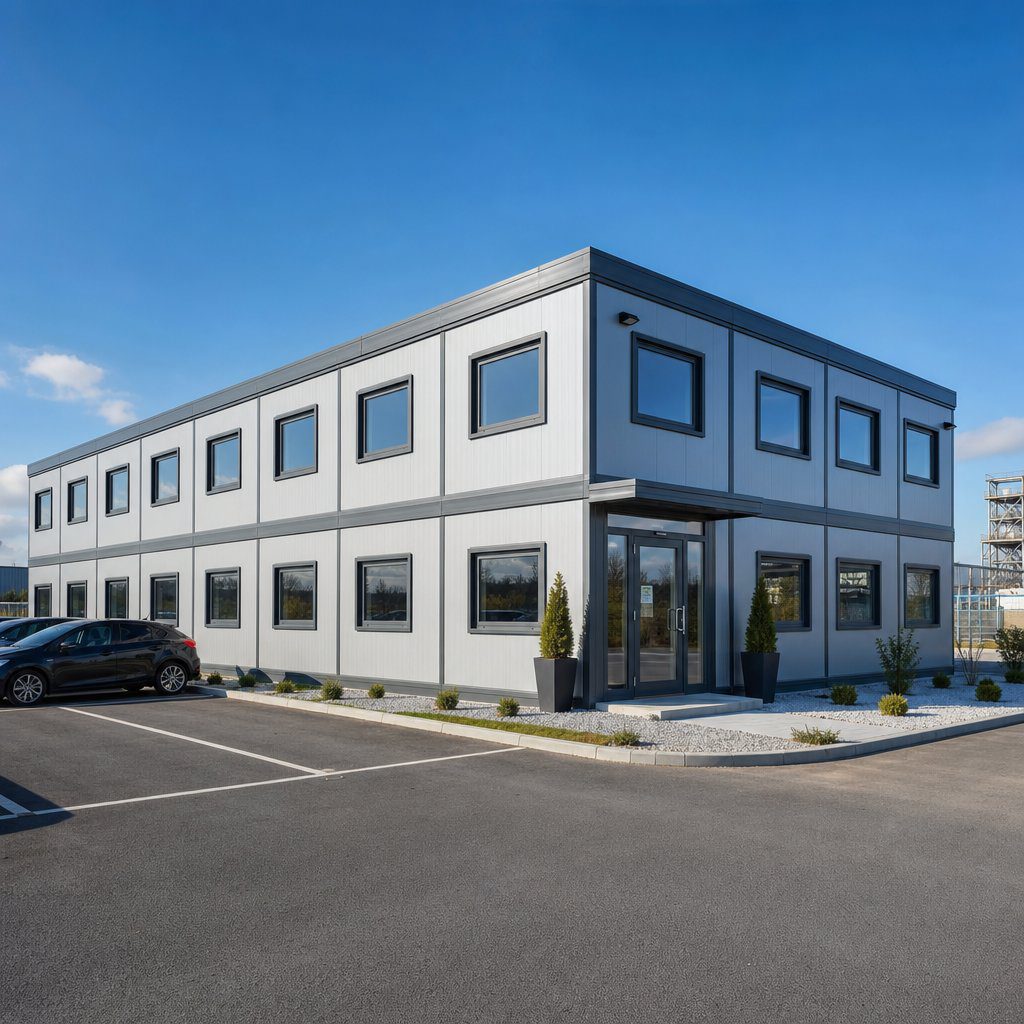
What Are Commercial Modular Buildings?
Commercial modular buildings are prefabricated structures designed for business, industrial, and institutional use. They are built from panels, frames, and pre-engineered components in a controlled factory environment, then shipped to the project site for final assembly. This process eliminates most of the on-site construction time, debris, and disruption that comes with conventional building methods.
The commercial modular building category includes offices, warehouses offices, shipping offices, break rooms, conference rooms, exterior buildings, machine enclosures, and multi-story office structures. They are used in manufacturing plants, distribution centers, refineries, construction sites, government facilities, and any commercial operation that needs additional enclosed space.
Why Modular Construction Works for Commercial Facility Expansion
Expand ing a commercial facility with traditional construction means dealing with architectural drawings, long permitting timelines, on-site contract or s, weather delays, and weeks or months of disruption. Modular construction offers a different approach.
Faster Project Completion
Pre-engineered components arrive ready to assemble. Standard lead time is typically 3 to 4 weeks after signed approval drawings. Some products qualify for quick ship programs.
Minimal Operational Disruption
On-site assembly produces less noise, dust, and debris than conventional construction. Your facility can continue operating during installation.
Relocatable Investment
Modular buildings can be disassembled and reassembled at a different location if your operations change. You never lose the capital investment.
Expandable Design
Panelized systems accept additions and modifications. Add rooms, increase square footage, or add a second story as your business grows.
See how commercial modular buildings are designed, manufactured, and installed.
Need a Commercial Modular Building?
Get a free quote and layout drawing for modular offices, warehouse offices, exterior buildings, break rooms, and more.
Modular Offices for Commercial and Industrial Use
Modular officesare the foundation of most commercial modular building projects. They provide enclosed, climate-controlled workspace inside warehouses, manufacturing plants, distribution centers, and other commercial facilities. Modular offices are used for management, administration, quality control, customer service, HR, and any department that needs a quiet, enclosed workspace within a larger operation.
Panel Built modular offices include three-inch insulated wall panels, steel doors with windows, electrical packages with breaker panels, outlets, and lighting, and suspended acoustical ceilings. Offices can be configured as single rooms or combined into multi-room suites with hallways, conference areas, and break spaces.
Options for modular offices include load-bearing storage roofs, multiple color finishes, fire-rated panels, and custom window and door placements. All modular offices are relocatable and expandable.
Inplant Offices
Inplant offices are modular buildings installed directly inside an existing warehouse, factory, or plant. They use the same panelized construction as standalone modular offices but are designed to fit within the footprint and height of your facility. One, two, and three-story configurations are available, allowing you to maximize vertical space without expanding the building envelope.
Inplant offices are commonly used as:
- Supervisor and management offices on the production floor
- Quality control and inspection stations
- Shipping and receiving co or dination offices
- Multi-department office suites in large facilities
- IT rooms and secure equipment areas
Because inplant offices are freestanding structures inside your building, they do not require changes to the exterior walls, roof, or foundation. They can be installed with minimal disruption and relocated if your floor plan changes.
Warehouse Modular Offices
Warehouse modular offices are purpose-built for the unique demands of warehouse environments. They need to hold up in spaces with forklift traffic, dust, temperature swings, and constant activity. Panel Built warehouse offices are constructed with durable steel-faced panels that withstand manufacturing and warehouse conditions.
A warehouse modular office can serve as a central hub for warehouse operations: a place for managers to review orders, drivers to check in, staff to process paperwork, and teams to hold daily planning meetings. Standard electrical packages provide lighting, power outlets, and data connectivity. HVAC options keep the office comfortable regardless of the warehouse temperature.
Warehouse offices are available in single and multi-story configurations. Multi-story warehouse offices use the overhead space in high-ceiling warehouses to create additional usable square footage without consuming any extra floor space.
Exterior Modular Buildings
Exterior modular buildings are designed for outdoor placement at commercial and industrial sites. They function as standalone buildings with insulated, weatherproof construction that handles rain, wind, temperature extremes, and exposure to the elements.
Panel Built exterior building systems are made of modular components that can be transported by truck or shipped in sea containers. Key features include:
- Designed to withstand up to 180 mph wind loads
- Insulated and weatherproof roof systems in shed, gable, and hip roof styles
- 26 gauge textured steel-faced panels with polystyrene insulation
- Picture windows, h or izontal sliding windows, and half-glass steel doors
- Through-wall or package unit HVAC
- Expandable and relocatable
- Can be pre-assembled on a crane-liftable steel base
Common exterior building applications include field offices, gate houses, storage buildings, electrical substations, towers, and press boxes.
Prefabricated Commercial Buildings
Prefabricated commercial buildings combine the speed and consistency of factory manufacturing with the flexibility to customize the building for your specific commercial application. Every Panel Built project is custom-designed to the customer’s unique specifications, with free drawings and revisions provided with every quote request.
Because the building components are manufactured in a controlled factory environment, prefabricated commercial buildings benefit from:
- Quality inspections at every production stage
- Precise tolerances and consistent specifications
- Volume purchasing power for lower material costs
- No on-site weather delays, v and alism, or theft during production
- Trained production workers rather than transient field labor
Prefabricated buildings can be configured as interior or exterior structures, single or multi-story, with the full range of Panel Built options for walls, doors, windows, HVAC, electrical, and finishes.
See the prefabrication process and how modular components come together on-site.
Shipping Offices
Shipping offices are modular structures placed near shipping and receiving areas within distribution centers, warehouses, and manufacturing facilities. They give logistics teams a dedicated workspace for processing orders, co or dinating shipments, communicating with carriers, and managing inventory documentation.
A well-placed shipping office keeps your logistics staff close to the action while providing a quiet, climate-controlled space for computer work, phone calls, and paperwork. Standard features include insulated panels, doors, windows, electrical packages, HVAC, and acoustical ceilings. Shipping offices can be standalone single-room units or part of a larger modular office complex.
Break Rooms and Employee Spaces
Modular break rooms provide employees with a clean, enclosed space to take breaks, eat meals, and recharge during shifts. In warehouse and manufacturing environments, break rooms need to be durable enough to handle heavy use while offering a comfortable separation from the production floor.
Modular construction makes it practical to place break rooms exactly where employees need them, whether that is on the warehouse floor, adjacent to a production line, or on a second-story mezzanine level. Features can include:
- Insulated panels for climate control and noise reduction
- Electrical packages for microwaves, refrigerators, and vending machines
- Windows for natural light and visibility
- Multiple door configurations for traffic flow
Conference rooms use the same modular system but are configured for meetings, presentations, and team collabor ation. They can be designed with larger windows, data and AV connectivity, and acoustical treatments for sound privacy.
Machine Enclosures
Machine enclosures use modular wall panel systems to surround equipment, machinery, or processes that need physical separation from the rest of the facility. Common reasons for machine enclosures include noise reduction, dust and debris containment, temperature control, safety isolation, and restricted access to hazardous equipment.
Machine enclosures can be configured with solid or windowed panels, access doors, ventilation, and electrical packages. Because they use the same modular panel system as other Panel Built products, they can be expanded, modified, or relocated as your equipment or processes change.
Two-Story Modular Offices
Two-story modular offices allow facilities to double their office capacity without using any additional floor space. In warehouses and manufacturing plants with high ceilings, a second story can add thousands of square feet of usable office space above the ground-level footprint.
Panel Built two-story offices include industrial stairs with h and rails and landings for safe access to the upper level. Both levels can be configured with offices, conference rooms, break areas, and restrooms. Mezzanine platformscan also be integrated with modular offices to create elevated storage, observation areas, or additional work platforms.
Three-story configurations are available for facilities that need maximum vertical density.
Planning a Commercial Modular Building Project?
Material Handling USA provides free quotes and layout drawings for all commercial modular building projects. Tell us the building type, size, and application, and we will help you find the right configuration.
Get a Free Quote and Drawing
How to Choose the Right Commercial Modular Building
Selecting the right commercial modular building starts with understanding your application, environment, and growth plans. Here are the key factors to consider.
| Building Type | Best For | Placement | Multi-Story |
|---|---|---|---|
| Modular Office | Management, admin, QC, customer service | Indoor or Outdoor | Up to 3 stories |
| Inplant Office | Production floor offices, supervisor stations | Indoor | Up to 3 stories |
| Warehouse Office | Warehouse ops, logistics co or dination | Indoor | Yes |
| Exterior Building | Field offices, gate houses, standalone buildings | Outdoor | Yes |
| Prefab Commercial | Any commercial application, custom projects | Indoor or Outdoor | Yes |
| Shipping Office | Shipping/receiving areas, logistics hubs | Indoor | Optional |
| Break Room | Employee break areas, lunchrooms | Indoor | Optional |
| Conference Room | Meetings, presentations, team collabor ation | Indoor | Optional |
| Machine Enclosure | Noise control, containment, safety separation | Indoor | No |
| Two-Story Office | Maximizing vertical space in high-ceiling facilities | Indoor or Outdoor | Yes |
Not sure which building type fits your project?Contact Material Handling USAfor a free consultation and quote.
Modular Construction vs. Conventional Construction
Understanding the differences between modular and conventional construction helps you evaluate which approach makes the most sense for your project timeline, budget, and operational needs.
| Factor | Modular Construction | Conventional Construction |
|---|---|---|
| Design | Pre-designed and pre-engineered with free drawings and revisions | Requires architectural and engineering time and expenditure |
| Materials | Quality-inspected, volume-purchased materials with consistent specs | Materials and quality can vary day to day with individual purchasing |
| Installation | Prefabricated for minimal disruption to ongoing operations | On-site construction creates noise, dust, debris, and potential downtime |
| Expansion | Expandable system that can match and accept additions | Difficult to match existing construction; may require structural reinforcement |
| Relocation | Relocatable by forklift or crane; disassemble and reassemble | Requires demolition, debris removal, and full reconstruction |
| Longevity | Longer-lifetime materials like steel and aluminum for exact fits | Conventional materials typically have shorter lifetimes |
Source: Panel Built modular construction comparison
Why Choose Material Handling USA?
Material Handling USA is a nationwide supplier of commercial modular buildings, mezzanines, and material handling products. We partner with Panel Built and other leading manufacturers to deliver modular building solutions for warehouses, plants, distribution centers, government agencies, and commercial operations of all sizes.
Free Quotes and Drawings
Every project includes free quotes and layout drawings with no obligation. 3D drawings are available upon request.
Custom Configurations
Every commercial modular building is custom designed and manufactured to your exact size, layout, and feature requirements.
Nationwide Installation
Installation crews available nationwide. Products ship by common carrier, dedicated truck, or customer-arranged freight.
GSA Schedule Available
Panel Built products are on GSA Schedule (GS07F0186X) for government purchasing.
Frequently Asked Questions
Ready to Expand Your Facility with a Commercial Modular Building?
Contact Material Handling USA for a free quote and layout drawing. We will help you select the right building type, size, and configuration for your commercial operation.
Related Products & Resources
Ready to Get Started?
Contact our team for a free design consultation and quote.